Global Action Research Reports
- Title
- Global Action Research Reports
- Description
- The ICGS Global Action Research Collaborative is an 18-month action research program where educators in member schools study their classrooms to better understand effective teaching practices for girls. Their findings are published in our library every year.

Items
-
Encouraging Risk-Taking in Year 12 Girls Through a Collaborative Approach to Solving Non-Routine Questions in Higher Level MathematicsJanet Hunter (2023) 2023Maximising examination readiness for Year 12 students between the internal “trial” examinations and the final state matriculation examinations six school weeks later is always a challenge, especially in the higher levels of Mathematics. Traditionally girls complete a practice paper each week, correct their mistakes, then move onto the next one. They do not necessarily master the techniques they were unable to do or got wrong in the practice papers, leaving them open to the same errors in the final examination. This research project addresses this preparation loophole for a group of ten pre-matriculation girls studying the elite course, Mathematics Extension 2 in New South Wales, Australia. Three elements for girls’ success were identified and implemented as the action of this action research project: first, facilitating Year 12 girls to work collaboratively on mathematical problems to increase confidence; second, working on difficult, non-routine mathematical problems; and third, not providing solutions to mathematical problems. The results are encouraging and suggest that confidence increases by working collaboratively to the point where girls are fearless and ready to attempt questions individually; the skill required for success in the final external matriculation examination.
-
Examining the impact of a project based learning approach to teaching French how does it encourage confidence and self efficacy in girls independent problem solvingJo Orgill (2021) 2021Over the course of 15 lessons from September to November 2021, I undertook a project-based learning (PBL) approach to teaching French with 15 Year 8 girls. They worked independently to produce a video tour of their school for our partner school in France. In a mixed-methods research design, I examined the impact of this student-centered approach to language learning on the girls’ self-efficacy, confidence, and independent problem-solving skills. The PBL approach resulted in high pupil engagement, increased self-efficacy over time, as well as enhanced attainment and ability to problem-solve independently. The results led me to reflect on the importance of collaboration for girls in my setting as well as my use of pupil voice in my practice. This study contributes to the literature on self-efficacy in language-learning, with a particular focus on the benefits of a PBL approach for girls.
-
Exploring Conceptual and Critical Thinking: Using GenAI to Enhance Year 9 Girls' Understanding of Scientific ModelsLinda Zhe Jue Chui 2026This action research investigated the integration of generative artificial intelligence (GenAI) to support the development of conceptual and critical thinking in Year 9 (14–15-year-old) girls through scientific modelling. In school science classrooms, models are frequently used to introduce new content and abstract concepts; however, within the constraints of the densely packed New South Wales curriculum, in-class opportunities for explicit evaluation and critiques of models are often compromised. Consequently, students may continue to perceive science as a subject reliant on rote learning rather than requiring deep conceptual understanding. Over a 12-week period, a range of scientific models was introduced as course content progressed. These included physical models constructed by students, GenAI-generated models produced using CanvaAI, and evaluative tasks supported by both CanvaAI and Microsoft Copilot. Students were required to compare, critique, and refine these models, and, in some instances, receive written feedback from Copilot on evaluative modelling responses. Findings indicate growth in girls’ conceptual understanding, particularly through the comparison of GenAI-generated models with physical representations. Increased evidence of active learning was also observed during these modelling and evaluation tasks. However, for some students, limitations in their scientific knowledge contributed to instances of metacognitive laziness, particularly when tasks required higher-order evaluative judgement while comparing their own work with GenAI outputs. Overall, students were able to pause and review GenAI outputs with greater precautions. They also included more appropriate details when answering scientific modelling questions that required their applications of evaluative skills, demonstrating improved critical thinking skills.
-
Facilitating Ownership in Social-Emotional Learning: Grade 3 Girls’ Co-Created Mindful Routines Foster Self-Regulation and Resiliency SkillsAnnMarie Zigrossi (2023) 2023This action research project explores how 7-8 year-old girls co-created mindful routines as a strategy to foster self-regulation and resiliency. This research was conducted with a group of 14 Grade 3 students at an all-girls independent school in Toronto, Canada. The project examined how students could more independently access taught mindfulness strategies when faced with challenges throughout their day. While most research in this area focuses on the beneficial outcomes of participating in mindfulness practices and the long-term positive effects on academics and social interactions, there is less information on how students can more independently access these practices in their daily lives. In this project, the girls created a well-structured mindful routine that they practised each morning and had access to throughout their day. Students exhibited a sense of ownership in creating their unique mindful routine, which led to high levels of engagement and autonomy. The students used critical thinking skills to research various mindful practices and experimented, tested, and self-reflected to discern the practices that best suited them. Data were collected while the girls participated in their individual mindful routine each morning over a six-week period. Data collected were qualitative in nature and captured by questionnaires, interviews, observations and student journals. The results indicated that the students independently accessed this tool to support them through regular daily challenges, such as working through feeling frustrated or overwhelmed, resolving conflicts with peers at recess, and managing anxiety at competitive sporting events. The girls articulated the positive impact of using their mindful routine and how they plan to use this tool in the future. These mindful routines were used as a tool for self-regulation and demonstrated the development of resiliency skills that students can access throughout their lives to enhance their well-being. Facilitating young students’ creation of mindful routines to develop these skills and recognize their immediate positive impact will be key in the school’s future planning of Social-Emotional Learning (SEL). By AnnMarie Zigrossi
-
Feedback Conversations to Motivate Adolescent Girls’ Learning: Using Conversations to Progress Learning, Resilience, and ConfidenceKaren Lewis (2020) 2020There is often a disconnect between the feedback teachers give and their students’ willingness or ability to apply that feedback to their own writing. Teachers understand, though, that the way they give feedback can impact student confidence and resilience. For girls as social learners who value relationships, some form of dialogue can help to facilitate uptake of feedback and potentially support confidence and resilience. There is not an extensive body of research, however, that explores the experiences of feedback specifically for adolescent girls. In response to this, action research on student engagement with feedback was undertaken in a large all-girls’ school in Brisbane, Australia. A group of thirty-six Year 11 English Literature students engaged in feedback conversations to encourage clarification of feedback and self-evaluation of their work. Feedback conversation transcripts, student surveys, focus group discussions, and student grades were used to find the impact of such conversations on student confidence, uptake of feedback, and improvement to their writing. Those students who engaged with feedback conversations reported feeling positive about their own learning, having improved confidence towards their potential exam performance, being more receptive to feedback, and had an increase in overall grades under exam conditions. Further research on the impact of prolonged use of feedback conversations is warranted, especially related to student confidence, resilience, and writing performance.
-
Fostering Engagement in a Year 10 Girls’ Biology Classroom through Development of a Collaborative CultureClaire Saxon (2024) 2024Whilst girls demonstrate a propensity for social learning, classroom collaboration does not always lead to positive outcomes. Working together can lead to dissatisfaction, a reduction in engagement and a reliance on formulaic presentations rather than embracing a love of learning in a Year 10 Biology classroom. Girls at my school have been observed to collaborate effectively in Drama or Physical Education lessons but unable to transfer this skill to Biology. The aim of this action research project was to enable girls to change the perception of success in Biology and gather evidence of any change. This was the inspiration for an examination of re-addressing the balance in a more teacher-led classroom by adapting Ritchhart and Church’s (2020) routines in The power of making thinking visible. Girls in a Year 10 Biology class at Wycombe High School were participants in a study where deliberate routines were planned and delivered in a sequence of Biology lessons to engage students in learning and working together to achieve a common goal. Data were collected as part of a mixed methods approach. Data analysis suggested an increase in feelings of belonging and inclusion. Themes of academic trust, and the ability of students to use and organically apply the skills they learned during the collaborative learning activities were identified. Initial evidence also suggests that anxiety decreased as students were able to build critical relationships and trust with their peers whilst exploring more abstract ideas. The findings also indicate that girls were more likely to participate in robust learning conversations after the action. The intended outcomes served to challenge the apparent predominant pedagogy in different contexts which had been observed in a high-achieving, single-sex girls’ school and to foster a collaborative culture in areas where this is not usually expected. To develop this study further, there is a need to explore the relationship between collaboration, academic trust, and metacognition.
-
Fostering Grade 9 Girls’ Sense of Belonging Through the Use of Collaborative Lab Practicums as Authentic Assessments in ScienceAruna Chavali (2024) 2024In 2023, the gender gap in STEM remains significant, with women making up only 28% of the STEM workforce (UNESCO, 2023). Research suggests that fostering a sense of belonging in secondary Science classes is an effective strategy for increasing and sustaining the participation of girls in the STEM pipeline (Hansen,2023). The three guiding principles for a student to have a sense of academic belonging are interpersonal relationships, disciple identity, and a growth mindset (CELT Teaching Briefs). This action research project investigated how collaborative lab practicums, as authentic assessments, cultivated discipline identity, and promoted a growth mindset, to foster a sense of belonging for girls in a Grade 9 Physics classroom. The research, conducted at The Spence School, an all-girls K-12 institution, employed a mixed-methods approach, combining Likert-scale surveys, field observations, video recordings, and interviews. Twenty-nine Grade 9 students participated in this study. Findings indicate that collaborative lab practicums deepened students' understanding, and promoted collaborative learning. Students valued the hands-on, real-world application of theoretical knowledge, which facilitates a deeper connection to science. Additionally, the collaborative nature of the assessments encouraged teamwork and enhanced communication skills. The majority of students exhibited a growth mindset, emphasizing the importance of redoing and revising calculations as part of the learning process. While challenges, such as the fast-paced nature of practicums, were noted, overall, students expressed a preference for this collaborative, authentic learning approach. This study contributes valuable insights into fostering a positive sense of belonging in the Science classroom which could ultimately increase the participation of girls in the STEM pipeline.
-
Fostering Resilience Through Quality Feedback in One-on-One MentoringNúria Tapias Nadales (2020) 2020La Vall is a girls’ school located in Bellaterra (near Barcelona) with approximately 1,500 students between 1 and 18 years old, and belonging to Institució Familiar d'Educació , an educational institution with 13 schools in Catalonia and the Balearic Islands. The school’s main objective is to offer a personalized education model, based on the five dimensions of the person (physical, affective, social, rational, transcendental) that are described in the Integral Human Development theory. This study aimed to explore through surveys, interviews, and self-reflection how feedback in one-on-one mentoring is beneficial to secondary female students’ (13-16 years old) personal and academic progress, considering the five dimensions of the person mentioned above, and how appropriate feedback may enhance self-confidence and growth, and thus resilience. The outcomes of this action research suggest mentoring is an effective tool in resilience development when there is a trusting relationship between student and mentor, and when goals and action plans are student-initiated. Adequate training and time allocation seem necessary tools to ensure effective mentoring that promotes the development of protective factors that result in resilience and balanced growth.
-
From AI Consumption to Co-Thinking: How Structured Evaluation Enhances Year 9 Girls’ Critical Thinking in Science InquiryJo Oreo 2026This action research examines how structured evaluation of AI-generated outputs shapes girls’ critical thinking. This study was motivated by concerns that generative artificial intelligence (GAI) may encourage surface-level learning and cognitive offloading when girls use it primarily for quick responses, particularly in the absence of explicit scaffolding for critical and ethical engagement. A purpose-designed co-thinking framework was implemented within a Year 9 Science inquiry unit in an independent girls’ school to support girls to “co-think” with AI while maintaining ownership of their ideas. Data from student portfolios, surveys, classroom observations, and interviews indicated a shift from using AI for quick answers toward more deliberate co-thinking, with greater attention to accuracy, bias, and limitations, alongside increased cross-checking, prompt revision, and clearer differentiation between students’ ideas and AI contributions. Overall, the findings indicate that the impact of GAI depends less on the technology itself and more on pedagogical design. When evaluation is explicitly scaffolded, students engage more critically with AI, using it to test and refine ideas rather than accept outputs at face value. Student feedback from this research informed the refinement of this framework, now supporting broader whole-school approaches to critical thinking and ethical engagement with GAI.
-
From Automation to Agency: Using AI to Strengthen Year 12 Girls’ Critical ThinkingTina Huang 2026As generative Artificial Intelligence (AI) tools become increasingly accessible, the need for students to critically evaluate and interpret automated feedback has become more pressing than ever. Furthermore, concerns have emerged regarding students’ tendency to engage with AI passively or treat its outputs as authoritative. This action research study investigated whether structured engagement with AI-generated feedback could strengthen evaluative critical thinking skills in Year 12 English students within a private all-girls school context in Brisbane, Australia. In response to growing concerns, this study implemented a structured framework in which a class of 23 girls were explicitly taught how to critique, reflect, and selectively apply AI-generated feedback to their own essay writing. Scaffolded reflective checkpoints and peer dialogue were embedded to support the development of evaluative judgement and independent learning. Data collection techniques included written student reflections, questionnaire responses, focus groups, interview clips and transcripts and lesson observations. Thematic analysis was used to interpret the data, with findings indicating that students demonstrated increased evaluative awareness, greater intentionality in their use of AI, and strengthened confidence in their own academic judgement. These findings are valuable for educators navigating AI integration in secondary classrooms and warrant further investigation, particularly in exploring the long-term development of evaluative judgement across year levels.
-
Giving the Bird Wings: AI as a Mathematical Coach for Year 8 GirlsSusan Jackson 2026Many studies highlight the importance of fostering mathematical confidence in early adolescence, particularly among girls, who often experience a decline in self-efficacy despite capable performance (Zander et al., 2020). My action research explored how using AI-generated prompts to guide Year 8 girls through the MPTC (Make sense, Plan an approach, Take action, Convince yourself and others) mathematical investigation cycle built confidence in non-routine mathematics challenges. Over 16 weeks, 22 Year 8 students engaged with a custom AI chatbot designed to scaffold their work on non-routine, challenging problems using the MPTC cycle. Using a mixed-methods approach, the study employed Mertler's (2020) inductive analysis to identify patterns in the collected data. I constructed four key themes: refined AI-generated prompts build student trust and confidence; confidence grows when AI provides scaffolds rather than solutions; students internalise the MPTC cycle through repeated guided use; and non-judgmental AI interaction increases confidence and fosters agency. My findings revealed that a carefully designed AI chatbot significantly increased participants' confidence when the tool prioritised conciseness, developmental appropriateness, and step-by-step metacognitive checking. This research demonstrates that AI, designed as a pedagogical coach rather than an answer generator, can empower girls to embrace productive struggle and see themselves as capable mathematicians. Implications for practice include the critical importance of prompt engineering and the potential for AI to build mathematical confidence in early adolescent girls.
-
Glass-Box Feedback: Turning AI Chatbots into Metacognitive Writing Partners for Year 5 GirlsMakiko Ryland 2026Many students approach writing as a task to complete rather than a process of drafting, reflecting and refining ideas. This action research project investigated how AI-generated feedback influenced Year 5 girls’ metacognitive engagement and revision practices in writing within a primary school context in Sydney, Australia. With generative AI increasingly present in classrooms, there is a need to understand whether AI feedback can support revision without replacing students’ thinking. The 10-week intervention involved designing and implementing a custom AI chatbot, Blue Bot. Blue Bot was co-constructed with students through shared success criteria, task-specific rubrics, and clear guardrails to shift AI from a “black box” to a “glass-box” tool. Students engaged in repeated drafting cycles: writing an initial draft, receiving rubric-aligned AI feedback, revising independently, and submitting a second draft for teacher assessment. A mixed-methods approach was used to collect data through student journals, pre- and post-intervention surveys, focus group interviews, chatbot interaction logs, teacher field notes, and rubric-scored writing samples with calculated revision gains. Findings indicate that, when explicitly scaffolded, AI feedback can strengthen evaluative judgement and support deeper revision beyond surface editing. However, the impact of AI feedback varied depending on students’ perceptions of the chatbot, and some learners (including EALD and lower-achieving writers) required additional scaffolding to interpret and apply feedback. The study highlights the importance of transparent design, explicit teaching and “human in the loop” principles to ensure AI supports metacognitive growth and equitable access to revision improvement.
-
History Belongs to Us: Year 9 Girls Use Historical Significance to Craft Their CurriculumHolly Webb 2025This action research study investigated the impact of applying the skill of historical significance to meaningfully involve girls in the creation of their Year 9 history curriculum. A class of 25 girls was given explicit instruction on evaluating historical significance, and the girls were provided with multiple opportunities to evaluate the significance of the historical topics they were currently studying. The project culminated with students producing independently researched proposals for new topics they believed warranted inclusion in the school's Year 9 history curriculum, and also with the History department working with the students to implement some of these changes. Data collection techniques included questionnaires, focus groups, student work samples, and lesson observations. Thematic analysis was used to interpret the data; findings revealed that involvement in the curriculum design process and application of historical significance enhanced student agency and developed girls’ historical skills. Developing the skill of historical significance also enabled girls to distinguish between the agency of a historian and personal preferences, whilst also highlighting that comprehensive historical knowledge is crucial for students to effectively evaluate significance and exercise agency. The findings from this study are valuable for educators wanting to critically reflect on what may be considered canon in their subject or those hoping to involve students in meaningful curricular change.
-
Making the Stumble Part of the Dance: Using Improvisational Gameplay to Empower Year 8 Girls to Courageously Collaborate in a Social Entrepreneurial ProgramSamanda Sankowsky (2024) 2024This action research project explored how 13 to 14 year-old girls engaged in improvisational gameplay activities to empower them to courageously collaborate in a social entrepreneurial program. The research was conducted with a group of 17 Year 8 students at an all-girls independent school in Perth, Western Australia. The project examined how in social entrepreneurial teams of four to five, girls participated in one 5-10-minute improvisational gameplay warm up each lesson that didactically explored and developed a “toolkit” of fundamental collaborative skills and processes. The research tracked the effectiveness of this toolkit when girls applied it to their collaborative social entrepreneurial project as their group pitched, designed, manufactured, and sold a market product that advocated for a local charity in support of a United Nations Sustainable Development Goal (SDG). Both qualitative and quantitative data including questionnaires, rating scales, interviews, observations, and student reflections were collected as the girls participated in and reflected upon the process over a 10-week period. The results indicate that the girls exhibited a greater sense of joy towards collaboration, and this allowed them to develop not only a better understanding of the skills associated with social entrepreneurship but inspired them to strive for personal growth in this role. The girls were taking collaborative risks more frequently with their peers and expressed that they were better equipped with the tools to embrace mistakes and transform them into innovative possibilities or solutions. All in all, throughout the development and application of their improvisational toolkit, the girls’ felt that their voices were projected with greater confidence and collective equity, both in their collaborative groups and in their role as a social entrepreneur in the broader school community.
-
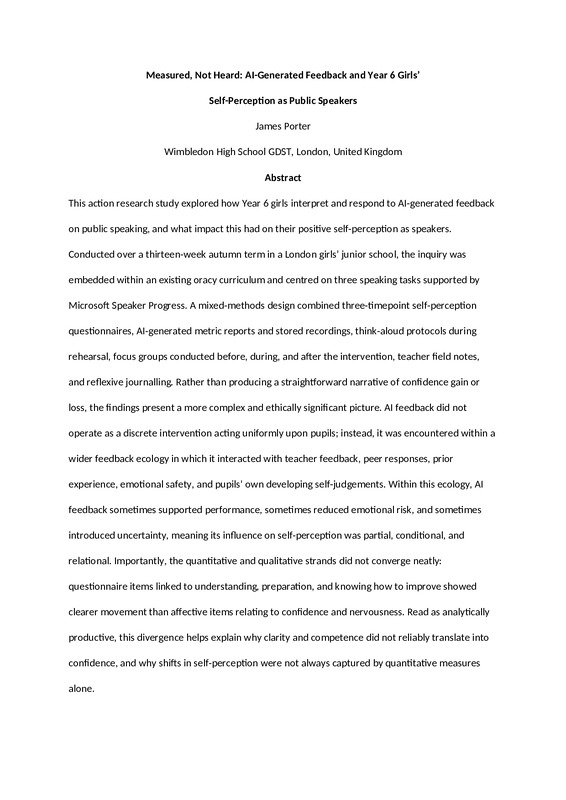
Measured, Not Heard: AI-Generated Feedback and Year 6 Girls’ Self-Perception as Public SpeakersJames Porter 2026This action research study explored how Year 6 girls interpret and respond to AI-generated feedback on public speaking, and what impact this had on their positive self-perception as speakers. Conducted over a thirteen-week autumn term in a London girls’ junior school, the inquiry was embedded within an existing oracy curriculum and centred on three speaking tasks supported by Microsoft Speaker Progress. A mixed-methods design combined three-timepoint self-perception questionnaires, AI-generated metric reports and stored recordings, think-aloud protocols during rehearsal, focus groups conducted before, during, and after the intervention, teacher field notes, and reflexive journalling. Rather than producing a straightforward narrative of confidence gain or loss, the findings present a more complex and ethically significant picture. AI feedback did not operate as a discrete intervention acting uniformly upon pupils; instead, it was encountered within a wider feedback ecology in which it interacted with teacher feedback, peer responses, prior experience, emotional safety, and pupils’ own developing self-judgements. Within this ecology, AI feedback sometimes supported performance, sometimes reduced emotional risk, and sometimes introduced uncertainty, meaning its influence on self-perception was partial, conditional, and relational. Importantly, the quantitative and qualitative strands did not converge neatly: questionnaire items linked to understanding, preparation, and knowing how to improve showed clearer movement than affective items relating to confidence and nervousness. Read as analytically productive, this divergence helps explain why clarity and competence did not reliably translate into confidence, and why shifts in self-perception were not always captured by quantitative measures alone.
-
Practice Without Pressure: Using a Teacher-Trained AI Agent to Build Exam Writing Skills in a Year 12 Girls' VCE Visual Arts ClassroomPerri Winter 2026Over many years of teaching senior art, I noticed a persistent gap: students demonstrating genuine artistic sophistication in studio work were frequently unable to reproduce the same depth of thinking in written exam responses. This action research study investigated how a teacher-trained AI feedback agent, “Agent Art,” shaped ten Year 12 girls' independent exam preparation and analytical writing at Presbyterian Ladies' College (PLC) in Melbourne. I designed Agent Art as an exam practice partner trained on subject-specific content, rubrics, and Victorian Curriculum and Assessment Authority (VCAA) assessment criteria language. Using a mixed-methods, qualitative-led approach encompassing AI conversation logs, pre- and post-intervention surveys, a focus group, individual conversations, practice exam artefacts, and a reflexive researcher journal, I applied polyangulation and analysed data inductively through open, axial, and selective coding. I identified four themes as answers to the research question: girls engaged with Agent Art because they trusted the teacher behind it; they used it as a low-stakes space for checking and rehearsing rather than for high-stakes judgement; reading the conversation logs reshaped my teaching and in turn how girls prepared; and when the tool produced generic or inaccurate output, girls disengaged unless they had been taught to evaluate feedback critically. The findings suggest that a teacher-trained AI agent can meaningfully support girls' analytical writing when implemented with visible teacher oversight, relational trust, and explicit teaching of critical feedback literacy.
-
Ready, Set, GOAL! Using Chatbots to Increase 8th Grade Girls’ Confidence in SMART Goal SettingClaire Sargo 2026This action research project examined the effectiveness of a customized artificial intelligence (AI) chatbot in increasing 8th Grade girls’ confidence in setting SMART (Specific, Measurable, Achievable, Relevant, Time-bound) goals for computer science projects. Students often struggle with planning and organizing long-term projects. The SMART goal process is one method in which students can break down larger projects into more manageable parts. Twenty-one students participated in this 15-week study, utilizing the Flint educational AI platform to guide them through multiple iterations of the goal setting process. A mixed-methods approach was used for data collection, incorporating pre- and post-action questionnaires, exit tickets, chatbot transcripts, student interviews, video reflections, classroom observations, and class discussions to determine changes in student confidence and agency. Four key themes were identified from the data analysis: the tone and language of the chatbot had a significant influence on student engagement and SMART goal development; guidance from the chatbot increased student agency in creating SMART goals; students used the AI chatbot as a tool, but not a replacement for the teacher; and multiple iterations of the SMART goal setting process improved students’ levels of confidence and independence. The findings highlight the importance of balancing the use of AI tools in the classroom with teacher instruction. The use of AI technology in education has potential benefits and risks. The results of this study suggest that the relationship between teachers and students is an important factor in determining academic success. The importance of human interaction should not be underestimated by increased integration of technology tools. As future technology tools are introduced, teachers should continue to be the instructional leaders of the classroom. Technology should remain in its role as a supporting actor. Ready, Set, GOAL! Using Chatbots to Increase 8th Grade Girls’ Confidence in SMART Goal Setting
-
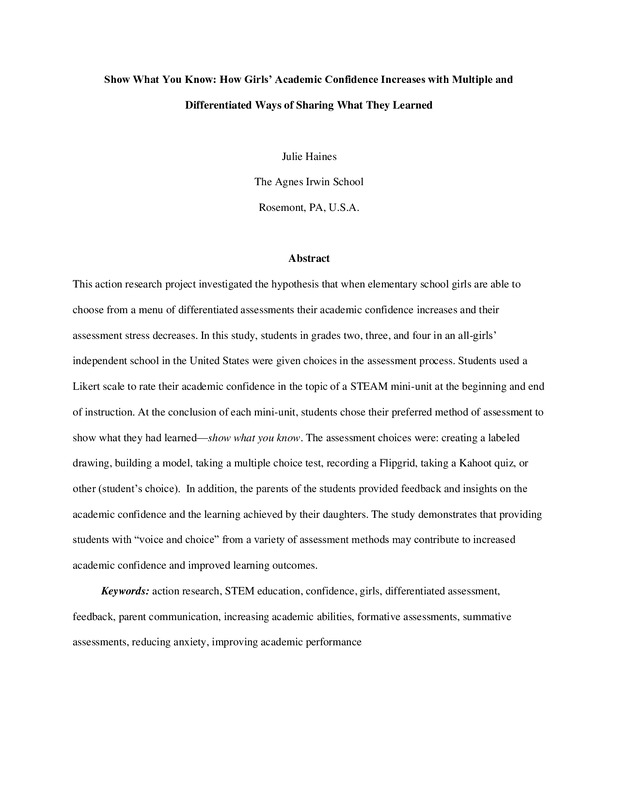
Show What You Know: How Girls’ Academic Confidence Increases with Multiple and Differentiated Ways of Sharing What They LearnedJulie Haines (2020) 2020This action research project investigated the hypothesis that when elementary school girls are able to choose from a menu of differentiated assessments their academic confidence increases and their assessment stress decreases. In this study, students in grades two, three, and four in an all-girls’ independent school in the United States were given choices in the assessment process. Students used a Likert scale to rate their academic confidence in the topic of a STEAM mini-unit at the beginning and end of instruction. At the conclusion of each mini-unit, students chose their preferred method of assessment to show what they had learned—show what you know. The assessment choices were: creating a labeled drawing, building a model, taking a multiple choice test, recording a Flipgrid, taking a Kahoot quiz, or other (student’s choice). In addition, the parents of the students provided feedback and insights on the academic confidence and the learning achieved by their daughters. The study demonstrates that providing students with “voice and choice” from a variety of assessment methods may contribute to increased academic confidence and improved learning outcomes.
-
The “Humans MATA” Reflection Framework: Empowering Year 10 Girls to Critically Analyse Their Use of Generative AI ToolsZoe Steer 2026As students continue to adopt Generative AI (GenAI) tools and technology at an accelerating rate, teachers have an urgent responsibility to guide its use. This requires teachers to support students in ways that empower them to think critically about their use of GenAI tools to support their learning and development, rather than hindering it. This action research inquiry explored how a series of AI literacy lessons and a bespoke framework titled “Humans MATA” empowered Year 10 girls (14–15 years old) to confidently and critically consider their use of GenAI tools. Employing a mixed-methods approach, this study captured student voice in the form of qualitative and quantitative data, fostering an intentional dialogue between student and teacher. The findings demonstrate how AI literacy lessons can develop student understanding and confidence about what GenAI tools are and how they work. Furthermore, the “Humans MATA” framework proved an effective reflective tool that empowered students to critically analyse their use of GenAI technology. However, despite targeted guidance from teachers and schools, some individuals may be less inclined to change their approach to using GenAI tools. These findings suggest that for AI literacy lessons to result in meaningful, long-term behavioural shifts, principles must be integrated consistently across both pastoral and subject-specific domains.
-
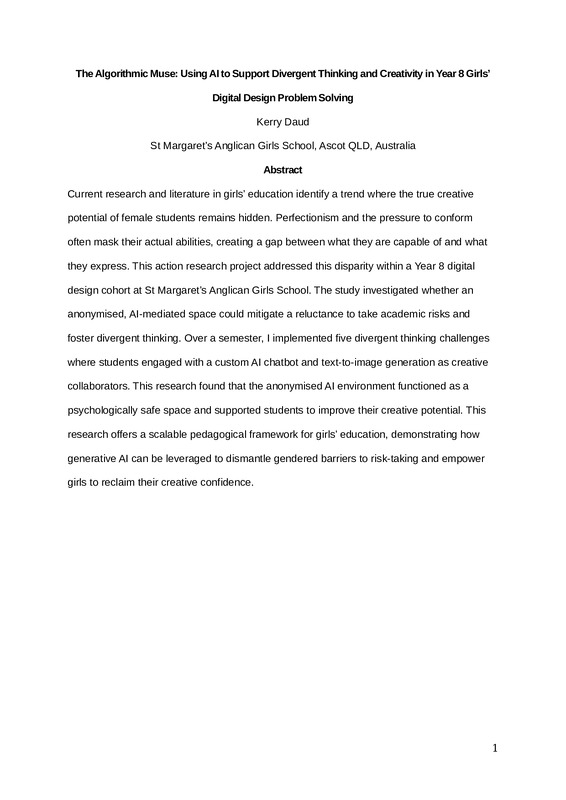
The Algorithmic Muse: Using AI to Support Divergent Thinking and Creativity in Year 8 Girls’ Digital Design Problem SolvingKerry Daud 2026Current research and literature in girls’ education identify a trend where the true creative potential of female students remains hidden. Perfectionism and the pressure to conform often mask their actual abilities, creating a gap between what they are capable of and what they express. This action research project addressed this disparity within a Year 8 digital design cohort at St Margaret’s Anglican Girls School. The study investigated whether an anonymised, AI-mediated space could mitigate a reluctance to take academic risks and foster divergent thinking. Over a semester, I implemented five divergent thinking challenges where students engaged with a custom AI chatbot and text-to-image generation as creative collaborators. This research found that the anonymised AI environment functioned as a psychologically safe space and supported students to improve their creative potential. This research offers a scalable pedagogical framework for girls’ education, demonstrating how generative AI can be leveraged to dismantle gendered barriers to risk-taking and empower girls to reclaim their creative confidence.
-
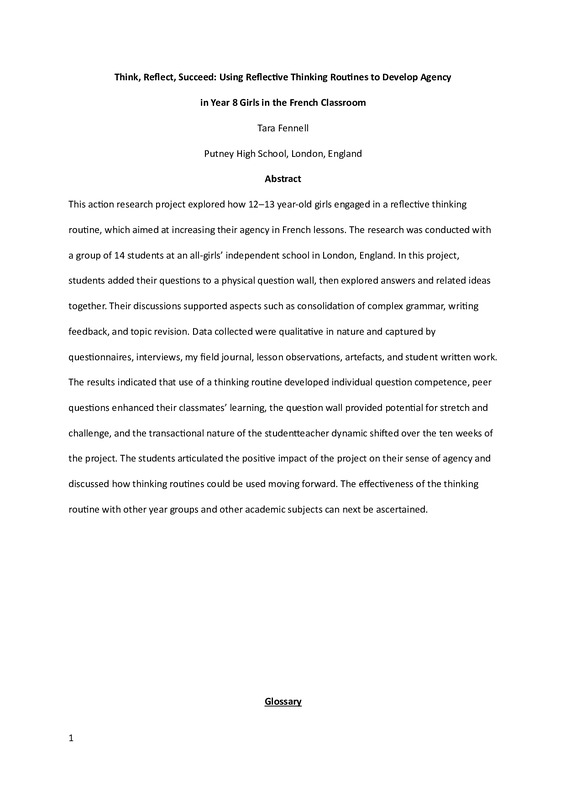
Think, Reflect, Succeed: Using Reflective Thinking Routines to Develop Agency in Year 8 Girls in the French ClassroomTara Fennell (2025) 2025This action research project explored how 12–13 year-old girls engaged in a reflective thinking routine, which aimed at increasing their agency in French lessons. The research was conducted with a group of 14 students at an all-girls independent school in London, England. In this project, students added their questions to a physical question wall, then explored answers and related ideas together. Their discussions supported aspects such as consolidation of complex grammar, writing feedback, and topic revision. Data collected were qualitative in nature and captured by questionnaires, interviews, my field journal, lesson observations, artefacts, and student written work. The results indicated that use of a thinking routine developed individual question competence, peer questions enhanced their classmates’ learning, the question wall provided potential for stretch and challenge, and the transactional nature of the student-teacher dynamic shifted over the ten weeks of the project. The students articulated the positive impact of the project on their sense of agency and discussed how thinking routines could be used moving forward. The effectiveness of the thinking routine with other year groups and other academic subjects can next be ascertained.
-
Using a Customised Chatbot to Facilitate Student Engagement in a Form III Physical Science ClassroomNikki Candy 2026This action research project aimed to improve student engagement in a Physical Sciences classroom, as I had observed that students who engaged consistently with the content experienced higher levels of success. The project explored how a customised chatbot was used to facilitate student engagement in a Form III Physical Science classroom. A class of 22 girls used the chatbot during chemistry lessons and then had the option of continuing its use for the remainder of the chemistry section. Based on students’ feedback, a second customised chatbot was deployed for the lessons on equations of motion, after which the girls had the option of continuing to use the chatbot to prepare for the final examinations. Data collection techniques included surveys, classroom observations, interviews, and chat histories between the girls and the customised chatbot. Thematic analysis was used to interpret the data and, where possible, correlations were made with existing literature. The key findings include the effectiveness of the customised chatbot in facilitating the girls’ engagement and the advantage of a platform that is immediate and accessible. The findings also show areas in which the technology requires further development, as inaccuracies lead to misconceptions. Furthermore, the findings highlight the complex nature of social interactions within a classroom and between the girls and the chatbots. The findings from this study are valuable for educators hoping to incorporate a customised chatbot into their teaching, as they provide a balanced view of the potential and limitations of the technology.
-
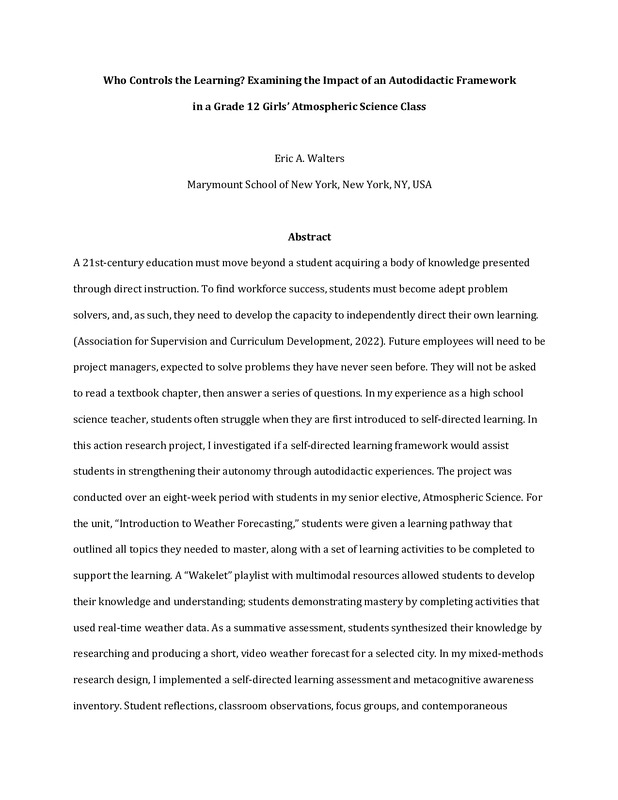
Who Controls the Learning? Examining the Impact of an Autodidactic Framework in a Grade 12 Girls’ Atmospheric Science ClassEric A. Walters (2023) 2023A 21st-century education must move beyond a student acquiring a body of knowledge presented through direct instruction. To find workforce success, students must become adept problem solvers, and, as such, they need to develop the capacity to independently direct their own learning. (Association for Supervision and Curriculum Development, 2022). Future employees will need to be project managers, expected to solve problems they have never seen before. They will not be asked to read a textbook chapter, then answer a series of questions. In my experience as a high school science teacher, students often struggle when they are first introduced to self-directed learning. In this action research project, I investigated if a self-directed learning framework would assist students in strengthening their autonomy through autodidactic experiences. The project was conducted over an eight-week period with students in my senior elective, Atmospheric Science. For the unit, “Introduction to Weather Forecasting,” students were given a learning pathway that outlined all topics they needed to master, along with a set of learning activities to be completed to support the learning. A “Wakelet” playlist with multimodal resources allowed students to develop their knowledge and understanding; students demonstrating mastery by completing activities that used real-time weather data. As a summative assessment, students synthesized their knowledge by researching and producing a short, video weather forecast for a selected city. In my mixed-methods research design, I implemented a self-directed learning assessment and metacognitive awareness inventory. Student reflections, classroom observations, focus groups, and contemporaneous comments also helped me understand changes in learning patterns. Data analysis suggested that students ended up in two camps: those with a fixed mindset who struggled with self-directed learning and those with a growth mindset who excelled with project planning. My results suggested that self-directed learning experiences must be carefully balanced with the students’ desire for collaborative work during learning. Furthermore, there must be an ongoing conversation between teacher and student about how students might understand their learning personas and thereby build agency in all types of learning.