
2025-26 GARC Research Reports: Navigating AI
- Title
- 2025-26 GARC Research Reports: Navigating AI
Items
-
 “I Am a Mathematician”: Using AI-Supported Planning to Build Numeracy Vocabulary and Identity in Year 1 GirlsDeane Valodimos 2026This action research project investigated how the AI tool Perplexity supported personalised numeracy vocabulary development for Year 1 girls in an all-girls Catholic school in Victoria, Australia. The study responded to evidence that gendered confidence gaps in mathematics emerge rapidly and that mathematical vocabulary is a key predictor of numeracy achievement and self-efficacy. Seven Year 1 girls, representing diverse language, educational and social backgrounds, participated in a six-week intervention embedded within daily numeracy sessions. Perplexity was used as a planning partner to generate explicit vocabulary-focused lessons aligned with the Victorian Curriculum and International Baccalaureate (IB) Primary Years Programme (PYP) outcomes, incorporating explicit instruction, guided practice and opportunities for independent application. Lessons featured AI-informed word walls, games, co-constructed definitions and visual supports, which were continuously adapted using assessment data and teacher judgement. Data were collected using a mixed-methods approach, including “Mathematics Online Interview” growth points, Essential Assessment pre- and post-tests, student work samples, mathematician journals, interviews, teacher observations, video reflections and a reflective teacher journal. Inductive analysis was used to organise, code and interpret the data across the action cycle. Findings indicate that when prompts deliberately encoded assessment data, vocabulary targets and clear structures, Perplexity-supported planning shifted tasks from closed-answer focused activities to open tasks that elicited rich strategy talk and more precise mathematical language. Most students demonstrated growth in numeracy vocabulary knowledge and use, alongside increased confidence in explaining strategies and a stronger sense of themselves as mathematicians. These findings indicate that AI can effectively enhance explicit vocabulary instruction and support personalised learning when it is mediated by teacher expertise and grounded in robust evidence of student learning. Together these findings also offer practical guidance for early years teachers who are seeking to use AI to personalise numeracy vocabulary instruction and disrupt emerging gendered patterns of confidence in mathematics.
 -
 A Safe Place for Productive Struggle: Using AI to Strengthen Year 6 Girls’ Self-Efficacy in MathematicsLauren Parker 2026This action research project investigated the impact of an AI-generated problem-solving platform on the mathematical self-efficacy of 24 Year 6 girls at Notting Hill and Ealing High School over twelve weeks. To foster independent problem-solving, teacher intervention was deliberately minimised, and the platform’s design omitted gamified metrics such as timers and scores; instead providing scaffolded discussion prompts for collaborative pairings and worked examples. Data were collected and triangulated through surveys, video interviews, focus groups, observations, and student reflections. Findings suggest an increase in self-efficacy, attributed to reduced social comparison, a shift from speed-based to perseverance-based success, and the development of autonomous problem-solving habits supported by collaborative practices. The results highlight that teacher-designed AI-generated learning environments can address gendered barriers to girls' self-efficacy in mathematics. Furthermore, this action research project offers broader pedagogical implications for mathematics teachers, highlighting how collaborative practice and activity design can create safer spaces for productive struggle to build girls’ self-efficacy.
 -
 Advancing Project-Based Learning Through Iterative AI Feedback: Strengthening Girls’ Confidence and Agency in Grade 9 Religious ExperienceMarianne Rule 2026The widespread accessibility of generative artificial intelligence (AI) has raised questions for educators regarding ethical use, student dependence, and intellectual agency. This mixed-methods action research study examined how iterative, teacher-calibrated AI feedback fostered girls’ confidence, feedback literacy, and intellectual agency during Grade 9 project-based learning in a Roman Catholic all-girls’ school. Sixteen girls participated in a 16-week classroom intervention centered on the Teacher-Calibrated Iterative Feedback Framework, which integrated AI-generated feedback, teacher conferencing, metacognitive reflection, and scaffolding reduction across iterative revision cycles. Data included pre- and post-surveys, student artifacts, reflections, AI interaction logs, teacher conference logs, interviews, and field notes, supporting polyangulation across student perceptions, feedback interactions, and revisions. Quantitative data were analyzed descriptively, and qualitative data were coded thematically to identify patterns in confidence and revision behavior. Findings indicated that students distinguished between exploratory AI feedback and evaluative teacher feedback, using each strategically. Over time, this differentiation was associated with increased confidence in revision decisions and strengthened intellectual agency in evaluating and applying feedback. Iterative feedback cycles supported by reflection and teacher conferencing also contributed to more critical engagement with revision processes. The study contributes an adaptable framework for integrating AI-supported feedback within project-based learning while preserving the central pedagogical role of the teacher. Findings suggest that calibrated feedback systems combining AI, reflection, and teacher expertise can support student agency and self-directed revision practices in secondary classrooms. These findings will inform continued implementation of the Teacher-Calibrated Iterative Feedback Framework in future project-based learning contexts.
 -
 AI-Supported Formative Feedback Reinforces Student Engagement and Confidence in a Grade 7 Girls’ Science ClassroomAlexander William John Stevens 2026This action research study examined how AI-supported formative feedback reinforces student engagement and confidence in a Grade 7 girls’ science classroom through structured opportunities for feedback, reflection, and revision. Grounded in research emphasizing the importance of timely, specific, and actionable formative feedback (Hattie & Timperley, 2007; Shute, 2008; Wiliam, 2016), the study explored the use of AI-driven learning checks through the FlintAI platform across biology and physics units over a ten-week period. Data were collected through pre- and post-intervention surveys, semi-structured interviews, structured classroom observations, and AI-generated performance summaries. Findings suggest that the immediacy and structure of the AI-supported feedback process reinforced student engagement and confidence by reducing uncertainty, clarifying learning expectations, and creating structured opportunities for reflection and revision. Classroom observations also suggested increases in behavioural and emotional engagement over time, including greater participation, more sustained on-task behaviour, and increased willingness to engage in discussion, and less frustration with the platform. Students further reported using actionable feedback to revisit and refine their thinking, suggesting deeper cognitive engagement with the material. Separately, AI-generated performance summary data indicated growth in the depth, coherence, and conceptual integration of students’ scientific reasoning. Although limitations related to sample size and continuity restrict generalizability, the findings highlight the potential of AI to complement effective teaching practice by functioning as a structured cognitive partner that supports engagement, confidence, and deeper scientific reasoning.
 -
 Beyond the Blank Page: Using AI Tools in Creative Writing to Cultivate Academic Buoyancy in GirlsNichola RiversThis action research study explored the impact of introducing AI planning and writing tools in the classroom to facilitate the production of Year 9 English students’ creative writing pieces. In my experience, students often struggled to initiate and sustain creative responses independently and my aim was to establish whether AI tools could aid students in improving this. A class of 20 girls was provided with access to three distinct AI tools during the planning and drafting of creative writing pieces across a unit of work. Throughout the unit, students were provided with explicit instructions on how to use the tools to assist them in their work. Using the tools, students produced three creative writing responses, two short descriptive pieces, and one extended narrative piece. Data collection techniques included student reflective journals, questionnaires, work samples, observations, and focus groups. Thematic analysis of the data revealed three main themes—using AI planning tools in creative writing tasks: increases girls’ confidence in task initiation; improves girls’ perceptions of their capacity to plan their writing effectively; and has a positive impact on girls’ sense of confidence and control over the quality of their writing. The findings of this study are valuable to educators who wish to explore practical applications of AI writing tools in the classroom and who wish to further explore the potential impact of AI on girls’ academic buoyancy, engagement, and performance.
 -
 Beyond the Prompt: Exploring How Critical Thinking Shapes Girls’ AI Usage Patterns in a Year 8 GALS Series ClassSydney Costa 2026This action research investigated the impact of critical thinking skills on AI output in Year 8 girls within the social emotional self identity course called GALS Series at the Girls Athletic Leadership School. This study was aimed towards supporting the development and use of an AI policy at the Girls Athletic Leadership School, GALS, by obtaining students' perspective and encouraging the use of critical thinking skills with AI output. I worked with a group of 8th Grade students in the GALS Series classroom to facilitate this research. Data were analyzed to assess how critically thinking about AI systems output influenced adolescent girls’ motivation to use an AI platform. Students participated in pre- and post-surveys, individual reflections, and small and whole group discussions. Ultimately, through engaging with ChatGPT in a multitude of ways, three key findings were identified: students verbally discussed a lack of diversity in generated images, shared a mistrust and questioning perspective with the written output, and individually reflected on the impacts of AI in their future.
 -
 Building Buoyancy: AI Coaching to Support Year 10 Girls Through Uncertainty in Historical InquiryNoni Harrison 2026This action research study investigated the impact of a custom artificial intelligence (AI) coach on Year 10 girls’ academic buoyancy during a seven-week historical inquiry project. The AI coach aimed to enhance students’ persistence through the cognitive and affective challenges of inquiry by providing stage-specific scaffolding aligned with Kuhlthau’s Information Search Process (ISP) (Kuhlthau et al., 2012) and the 5Cs of academic buoyancy (Martin & Marsh, 2008). Quantitative and qualitative data were collected within a convergent mixed-methods design. Thematic analysis revealed that AI coaching supported students’ academic buoyancy by normalising uncertainty and providing strategic guidance at critical stages. The findings highlight the potential of pedagogically designed AI coaching to extend teacher support and enhance students’ persistence in inquiry learning.
 -
 Co-Creating Confidence: Exploring AI as a Catalyst for Self-Regulated and Reflective Learning in Year 12 PsychologyJayne Schinckel 2026The integration of artificial intelligence (AI) into classroom practice presents new opportunities to enhance how students receive feedback and develop as autonomous learners. This action research project investigated the impact of Bloom AI as a Socratic tutor on the confidence, motivation, and self-regulated learning habits of 17–18-year-old girls in a Year 12 Psychology classroom and home learning environment while preparing for final examinations. The project was aimed at exploring how AI-powered, dialogic questioning could enhance learners’ metacognitive awareness and autonomy by replicating the cognitive prompts and scaffolding of one-to-one tutoring. Data were collected through baseline and follow-up surveys, focus group interviews, and platform usage analytics, capturing both the quantitative patterns of AI interaction and the qualitative reflections of students’ perceived growth. Findings revealed that immediate, conversational feedback fostered greater self-efficacy, reduced exam-related anxiety, and encouraged deeper engagement with content through self-questioning and reflection. The evidence suggests that AI Socratic tutoring can serve as a valuable pedagogical partner, supporting not only knowledge acquisition but also the development of independent, confident learners. This initiative aims to extend the use of Bloom AI across year levels and subject areas at St Hilda’s School, with the broader goal of inspiring educators in girls’ schools globally to leverage AI as a tool for empowerment, agency, and authentic learning.
 -
 Collaborating with “Ceci”: How a Teacher-Designed Chatbot Supports Writing Confidence in Grade 9 GirlsMary Jane Kennedy 2026This action research study examined how a teacher-designed chatbot (“Ceci”) supported writing confidence in 14 Grade 9 girls (14–15 years old) in an English classroom. This project was driven by a recurring revision challenge: students often identified issues in their writing but did not always know what to do next, and individualized feedback was difficult to provide consistently in real time. Data were collected across four structured revision sessions through surveys, chatbot transcripts, and classroom observations; writing artifacts were collected in the first two sessions and a focus group was conducted at the end of the study. Findings suggest that students saw Ceci as an extension of, rather than a replacement for, teacher feedback, using the chatbot for individualized support while still centering teacher expectations as they worked. Students’ writing confidence was most often expressed as procedural clarity, or their sense that they knew the next steps to take in revision. Although students sometimes found Ceci’s feedback frustrating or confusing, many demonstrated persistence by testing options, adjusting prompts, and making strategic decisions about how to apply Ceci’s feedback. Finally, Ceci’s relational design (name, avatar, gender, and tone) appeared to support both students’ engagement during revision and their willingness to admit uncertainty. Overall, these findings suggest implications for how a teacher-designed chatbot can extend revision support beyond a traditional classroom setting. A subsequent action-research cycle could standardize implementation and evaluate whether revisions strengthened clarity and connections in addition to confidence.
 -
 Confidence Through Customisation: AI-Generated Differentiation in a Year 10 Girls’ English ClassroomJemma Cattell 2026This action research study investigated whether artificial intelligence (AI) could effectively support readiness-based differentiation in a Year 10 girls’ English classroom, and how this influenced girls’ confidence and engagement. A class of 21 students participated in a seven-week unit in which AI-generated differentiated worksheets were embedded across non-fiction writing tasks. Students were grouped according to learning needs using cumulative reading and writing data, and for each text type, AI was used to produce tiered scaffolds tailored to differing levels of cognitive demand. Data collection techniques included confidence surveys at multiple intervals, weekly reflection journals, semi-structured interviews, classroom observations, teacher aide notes, and analysis of student writing artefacts. Thematic analysis was employed to interpret the data. Findings suggest that AI-generated tasks were able to differentiate appropriately, enabling students to access learning at an optimal level of challenge. Reduced procedural uncertainty enabled more targeted feedback and relational interaction, strengthening confidence and academic risk-taking. The intervention fostered a classroom culture characterised by collective perseverance and shared assurance. However, the effectiveness of AI-supported differentiation depended on deliberate teacher mediation and iterative refinement. The findings from this study may be valuable for educators seeking approaches to differentiation and exploring how emerging technologies can support inclusive pedagogy in girls’ schools without displacing professional expertise.
 -
 Developing AI-Security Self-Efficacy Through Prompt Injection Research in a High School ClassroomThomas Heverin 2026In high school cybersecurity classrooms, girls often experience a confidence gap when confronting the unpredictable and ill-defined vulnerabilities of modern artificial intelligence systems. This action research project examined how shifting students from passive users of AI tools to adversarial investigators through prompt injection testing influenced the AI-security self-efficacy of 12 girls enrolled in a high school Cybersecurity and Ethical Hacking class at The Baldwin School. Pre- and post-action surveys, student reflections, interviews, and work artifacts provided a comprehensive dataset capturing students’ transition from technical uncertainty to investigative authority. Findings indicate that self-efficacy increased substantially when girls engaged in mastery-based experiences that positioned them as active security researchers. Through iterative experimentation and creative prompt design, students successfully bypassed AI safeguards and demonstrated significant gains in confidence in their ability to analyze, question, and test AI systems. The findings also suggest that hands-on exploration of AI vulnerabilities promotes systems-level thinking, critical inquiry, and ethical awareness. While discovering the fragility of AI guardrails initially produced skepticism about the reliability of these technologies, this realization ultimately strengthened students’ sense of responsibility and agency in evaluating emerging AI systems. Future research should examine how adversarial exploration of AI technologies influences girls’ long-term persistence in cybersecurity pathways and how investigative learning models can support AI literacy and confidence among girls in secondary education. Developing AI-Security Self-Efficacy Through Prompt Injection Research in a High School Classroom To prepare students to navigate and lead in a digital landscape defined by rapid technological disruption, they must be empowered to see themselves as sophisticated agents of change rather than passive consumers of technology. However, girls in advanced technical domains often face a significant confidence gap where their belief in their own capabilities, rather than their actual abilities, serves as the primary barrier to participation (Francis et al., 2024). This is particularly visible in high-stakes fields like cybersecurity, where technical uncertainty can lead to a hesitation or worry about learning. The development of self-efficacy, as a core component of agency, is therefore essential to enable girls to boldly thrive and assert their authority in technical domains that have traditionally felt exclusionary, including cybersecurity and artificial intelligence (AI). Furthermore, according to Chiu et al. (2025), understanding how AI works represents a key step to living a safe and healthy life in a society dominated by AI.
 -
 Developing Discernment: The Intersection of Social Media, AI, and Critical Thinking for Year 6 GirlsHugh Earlam 2026This action research study sought to assess the impact of exposure to, and engagement with, generative artificial intelligence (Gen-AI) in a social media context, on girls’ critical thinking skills. The AI age has given birth to an unrealised deficit in discernment of what is, and what is not, real online; an issue this study intended to address. A class of 18 Year 6 girls (11-12 years old) from Seymour College, an independent all-girls Uniting Church school in Australia , were introduced to AI tools that were considered cutting edge at the time of the study and explored their impact on online media, such as video, image, and text generation. Students also created and engaged with their own non-digital social media platform to mimic the emotional experience of social media. These approaches set out to develop students’ critical thinking, focusing on the processes of inquiring, generating, analysing, and reflecting according to the Australian Curriculum and Reporting Authority (ACARA, 2026). This study used a mixed-methods approach to data collection through interviews, questionnaires, reflection, teacher observations, and student work. Findings identified that through prolonged exposure to AI-generated content, the students’ ability to think and speak critically improved. Students also built confidence in analysing content to seek its purpose and motivation. Most interestingly, students accepted the fact that social media will be part of their lives at some point, despite their newfound awareness of its pitfalls and risks. It is an interest of the researcher to assess the long-term efficacy of this intervention as the girls reach the age of 16, where, in Australia, social media will become legally available to them. An implication of this research is to see how soon this work can begin with younger students, and what possible interventions can assist girls who already use social media.
 -
 Empowering Design Thinking: The Role of Socratic AI Feedback in Developing Year 9 Girls’ Agency in Design EducationDavid Bratton 2026This action research project investigated the impact of automated, non-judgemental feedback on the agency of Year 9 girls within design and technology. To address the fear of failure and design fixation that often impede adolescent girls, I implemented a customised AI architect tool to support the design process and act as a supportive coach. This intervention transformed traditional, prescriptive teacher feedback into a space to receive low-stakes coaching dialogue. As part of a 13-week project at Bromley High School, students conducted an independent audit of the school site to pinpoint localised environmental problems and, in response, designed corresponding architectural solutions. The research followed a mixed-methods approach across three iterative cycles. While I initially provided various expert personas to support students in auditing the school site, recognising suitable locations, and constructing a formal design brief, the most effective feedback was Socratic in nature. By prioritising questioning over solution-giving, the AI encouraged critical thinking and empowered students to justify their own design decisions. An analysis of longitudinal growth in student voice, choice, and ownership, utilising reflection logs, interviews and questionnaires to gather qualitative insights, alongside quantitative data from radar charts. Findings revealed that this Socratic coaching model increased student confidence in independent decision-making. My research demonstrates that Socratic AI serves as a vital sounding board for creative risk-taking, addressing the fear of failure by enabling students to critically evaluate their ideas and reinforce design decisions through enhanced technical awareness. Building on this project, I intend to transform the design classroom into a space where the fear of failure is replaced by a culture of reflective and critical thinking across all age groups. I will implement Socratic feedback further by becoming a facilitator who encourages students to recognise and apply their own knowledge rather than providing the answers myself. For older students, AI assistants will serve as a vital sounding board, providing a dedicated space for Socratic learning and critical reflection that empowers them to validate their own ideas.
 -
 Exploring Conceptual and Critical Thinking: Using GenAI to Enhance Year 9 Girls' Understanding of Scientific ModelsLinda Zhe Jue Chui 2026This action research investigated the integration of generative artificial intelligence (GenAI) to support the development of conceptual and critical thinking in Year 9 (14–15-year-old) girls through scientific modelling. In school science classrooms, models are frequently used to introduce new content and abstract concepts; however, within the constraints of the densely packed New South Wales curriculum, in-class opportunities for explicit evaluation and critiques of models are often compromised. Consequently, students may continue to perceive science as a subject reliant on rote learning rather than requiring deep conceptual understanding. Over a 12-week period, a range of scientific models was introduced as course content progressed. These included physical models constructed by students, GenAI-generated models produced using CanvaAI, and evaluative tasks supported by both CanvaAI and Microsoft Copilot. Students were required to compare, critique, and refine these models, and, in some instances, receive written feedback from Copilot on evaluative modelling responses. Findings indicate growth in girls’ conceptual understanding, particularly through the comparison of GenAI-generated models with physical representations. Increased evidence of active learning was also observed during these modelling and evaluation tasks. However, for some students, limitations in their scientific knowledge contributed to instances of metacognitive laziness, particularly when tasks required higher-order evaluative judgement while comparing their own work with GenAI outputs. Overall, students were able to pause and review GenAI outputs with greater precautions. They also included more appropriate details when answering scientific modelling questions that required their applications of evaluative skills, demonstrating improved critical thinking skills.
 -
 From AI Consumption to Co-Thinking: How Structured Evaluation Enhances Year 9 Girls’ Critical Thinking in Science InquiryJo Oreo 2026This action research examines how structured evaluation of AI-generated outputs shapes girls’ critical thinking. This study was motivated by concerns that generative artificial intelligence (GAI) may encourage surface-level learning and cognitive offloading when girls use it primarily for quick responses, particularly in the absence of explicit scaffolding for critical and ethical engagement. A purpose-designed co-thinking framework was implemented within a Year 9 Science inquiry unit in an independent girls’ school to support girls to “co-think” with AI while maintaining ownership of their ideas. Data from student portfolios, surveys, classroom observations, and interviews indicated a shift from using AI for quick answers toward more deliberate co-thinking, with greater attention to accuracy, bias, and limitations, alongside increased cross-checking, prompt revision, and clearer differentiation between students’ ideas and AI contributions. Overall, the findings indicate that the impact of GAI depends less on the technology itself and more on pedagogical design. When evaluation is explicitly scaffolded, students engage more critically with AI, using it to test and refine ideas rather than accept outputs at face value. Student feedback from this research informed the refinement of this framework, now supporting broader whole-school approaches to critical thinking and ethical engagement with GAI.
 -
 From Automation to Agency: Using AI to Strengthen Year 12 Girls’ Critical ThinkingTina Huang 2026As generative Artificial Intelligence (AI) tools become increasingly accessible, the need for students to critically evaluate and interpret automated feedback has become more pressing than ever. Furthermore, concerns have emerged regarding students’ tendency to engage with AI passively or treat its outputs as authoritative. This action research study investigated whether structured engagement with AI-generated feedback could strengthen evaluative critical thinking skills in Year 12 English students within a private all-girls school context in Brisbane, Australia. In response to growing concerns, this study implemented a structured framework in which a class of 23 girls were explicitly taught how to critique, reflect, and selectively apply AI-generated feedback to their own essay writing. Scaffolded reflective checkpoints and peer dialogue were embedded to support the development of evaluative judgement and independent learning. Data collection techniques included written student reflections, questionnaire responses, focus groups, interview clips and transcripts and lesson observations. Thematic analysis was used to interpret the data, with findings indicating that students demonstrated increased evaluative awareness, greater intentionality in their use of AI, and strengthened confidence in their own academic judgement. These findings are valuable for educators navigating AI integration in secondary classrooms and warrant further investigation, particularly in exploring the long-term development of evaluative judgement across year levels.
 -
 Giving the Bird Wings: AI as a Mathematical Coach for Year 8 GirlsSusan Jackson 2026Many studies highlight the importance of fostering mathematical confidence in early adolescence, particularly among girls, who often experience a decline in self-efficacy despite capable performance (Zander et al., 2020). My action research explored how using AI-generated prompts to guide Year 8 girls through the MPTC (Make sense, Plan an approach, Take action, Convince yourself and others) mathematical investigation cycle built confidence in non-routine mathematics challenges. Over 16 weeks, 22 Year 8 students engaged with a custom AI chatbot designed to scaffold their work on non-routine, challenging problems using the MPTC cycle. Using a mixed-methods approach, the study employed Mertler's (2020) inductive analysis to identify patterns in the collected data. I constructed four key themes: refined AI-generated prompts build student trust and confidence; confidence grows when AI provides scaffolds rather than solutions; students internalise the MPTC cycle through repeated guided use; and non-judgmental AI interaction increases confidence and fosters agency. My findings revealed that a carefully designed AI chatbot significantly increased participants' confidence when the tool prioritised conciseness, developmental appropriateness, and step-by-step metacognitive checking. This research demonstrates that AI, designed as a pedagogical coach rather than an answer generator, can empower girls to embrace productive struggle and see themselves as capable mathematicians. Implications for practice include the critical importance of prompt engineering and the potential for AI to build mathematical confidence in early adolescent girls.
 -
 Glass-Box Feedback: Turning AI Chatbots into Metacognitive Writing Partners for Year 5 GirlsMakiko Ryland 2026Many students approach writing as a task to complete rather than a process of drafting, reflecting and refining ideas. This action research project investigated how AI-generated feedback influenced Year 5 girls’ metacognitive engagement and revision practices in writing within a primary school context in Sydney, Australia. With generative AI increasingly present in classrooms, there is a need to understand whether AI feedback can support revision without replacing students’ thinking. The 10-week intervention involved designing and implementing a custom AI chatbot, Blue Bot. Blue Bot was co-constructed with students through shared success criteria, task-specific rubrics, and clear guardrails to shift AI from a “black box” to a “glass-box” tool. Students engaged in repeated drafting cycles: writing an initial draft, receiving rubric-aligned AI feedback, revising independently, and submitting a second draft for teacher assessment. A mixed-methods approach was used to collect data through student journals, pre- and post-intervention surveys, focus group interviews, chatbot interaction logs, teacher field notes, and rubric-scored writing samples with calculated revision gains. Findings indicate that, when explicitly scaffolded, AI feedback can strengthen evaluative judgement and support deeper revision beyond surface editing. However, the impact of AI feedback varied depending on students’ perceptions of the chatbot, and some learners (including EALD and lower-achieving writers) required additional scaffolding to interpret and apply feedback. The study highlights the importance of transparent design, explicit teaching and “human in the loop” principles to ensure AI supports metacognitive growth and equitable access to revision improvement.
 -
 Measured, Not Heard: AI-Generated Feedback and Year 6 Girls’ Self-Perception as Public SpeakersJames Porter 2026This action research study explored how Year 6 girls interpret and respond to AI-generated feedback on public speaking, and what impact this had on their positive self-perception as speakers. Conducted over a thirteen-week autumn term in a London girls’ junior school, the inquiry was embedded within an existing oracy curriculum and centred on three speaking tasks supported by Microsoft Speaker Progress. A mixed-methods design combined three-timepoint self-perception questionnaires, AI-generated metric reports and stored recordings, think-aloud protocols during rehearsal, focus groups conducted before, during, and after the intervention, teacher field notes, and reflexive journalling. Rather than producing a straightforward narrative of confidence gain or loss, the findings present a more complex and ethically significant picture. AI feedback did not operate as a discrete intervention acting uniformly upon pupils; instead, it was encountered within a wider feedback ecology in which it interacted with teacher feedback, peer responses, prior experience, emotional safety, and pupils’ own developing self-judgements. Within this ecology, AI feedback sometimes supported performance, sometimes reduced emotional risk, and sometimes introduced uncertainty, meaning its influence on self-perception was partial, conditional, and relational. Importantly, the quantitative and qualitative strands did not converge neatly: questionnaire items linked to understanding, preparation, and knowing how to improve showed clearer movement than affective items relating to confidence and nervousness. Read as analytically productive, this divergence helps explain why clarity and competence did not reliably translate into confidence, and why shifts in self-perception were not always captured by quantitative measures alone.
 -
 Practice Without Pressure: Using a Teacher-Trained AI Agent to Build Exam Writing Skills in a Year 12 Girls' VCE Visual Arts ClassroomPerri Winter 2026Over many years of teaching senior art, I noticed a persistent gap: students demonstrating genuine artistic sophistication in studio work were frequently unable to reproduce the same depth of thinking in written exam responses. This action research study investigated how a teacher-trained AI feedback agent, “Agent Art,” shaped ten Year 12 girls' independent exam preparation and analytical writing at Presbyterian Ladies' College (PLC) in Melbourne. I designed Agent Art as an exam practice partner trained on subject-specific content, rubrics, and Victorian Curriculum and Assessment Authority (VCAA) assessment criteria language. Using a mixed-methods, qualitative-led approach encompassing AI conversation logs, pre- and post-intervention surveys, a focus group, individual conversations, practice exam artefacts, and a reflexive researcher journal, I applied polyangulation and analysed data inductively through open, axial, and selective coding. I identified four themes as answers to the research question: girls engaged with Agent Art because they trusted the teacher behind it; they used it as a low-stakes space for checking and rehearsing rather than for high-stakes judgement; reading the conversation logs reshaped my teaching and in turn how girls prepared; and when the tool produced generic or inaccurate output, girls disengaged unless they had been taught to evaluate feedback critically. The findings suggest that a teacher-trained AI agent can meaningfully support girls' analytical writing when implemented with visible teacher oversight, relational trust, and explicit teaching of critical feedback literacy.
 -
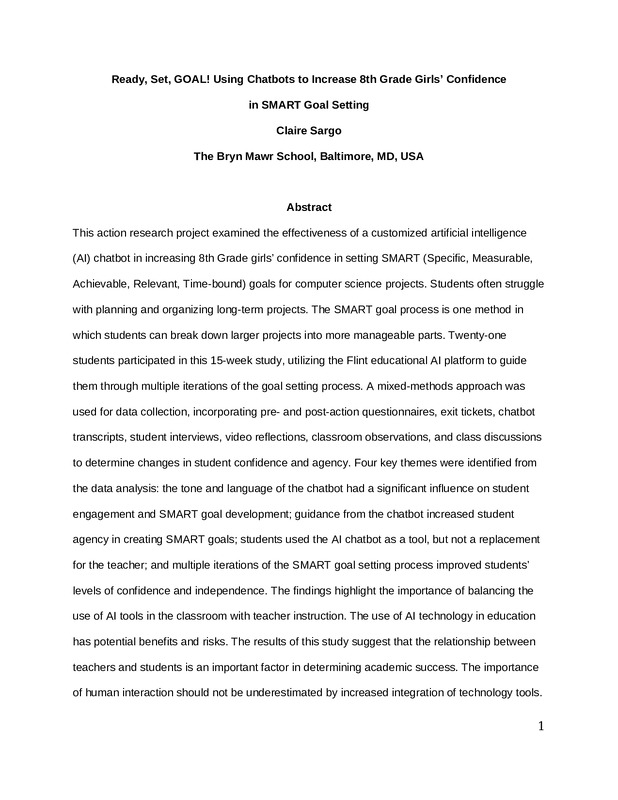 Ready, Set, GOAL! Using Chatbots to Increase 8th Grade Girls’ Confidence in SMART Goal SettingClaire Sargo 2026This action research project examined the effectiveness of a customized artificial intelligence (AI) chatbot in increasing 8th Grade girls’ confidence in setting SMART (Specific, Measurable, Achievable, Relevant, Time-bound) goals for computer science projects. Students often struggle with planning and organizing long-term projects. The SMART goal process is one method in which students can break down larger projects into more manageable parts. Twenty-one students participated in this 15-week study, utilizing the Flint educational AI platform to guide them through multiple iterations of the goal setting process. A mixed-methods approach was used for data collection, incorporating pre- and post-action questionnaires, exit tickets, chatbot transcripts, student interviews, video reflections, classroom observations, and class discussions to determine changes in student confidence and agency. Four key themes were identified from the data analysis: the tone and language of the chatbot had a significant influence on student engagement and SMART goal development; guidance from the chatbot increased student agency in creating SMART goals; students used the AI chatbot as a tool, but not a replacement for the teacher; and multiple iterations of the SMART goal setting process improved students’ levels of confidence and independence. The findings highlight the importance of balancing the use of AI tools in the classroom with teacher instruction. The use of AI technology in education has potential benefits and risks. The results of this study suggest that the relationship between teachers and students is an important factor in determining academic success. The importance of human interaction should not be underestimated by increased integration of technology tools. As future technology tools are introduced, teachers should continue to be the instructional leaders of the classroom. Technology should remain in its role as a supporting actor. Ready, Set, GOAL! Using Chatbots to Increase 8th Grade Girls’ Confidence in SMART Goal Setting
 -
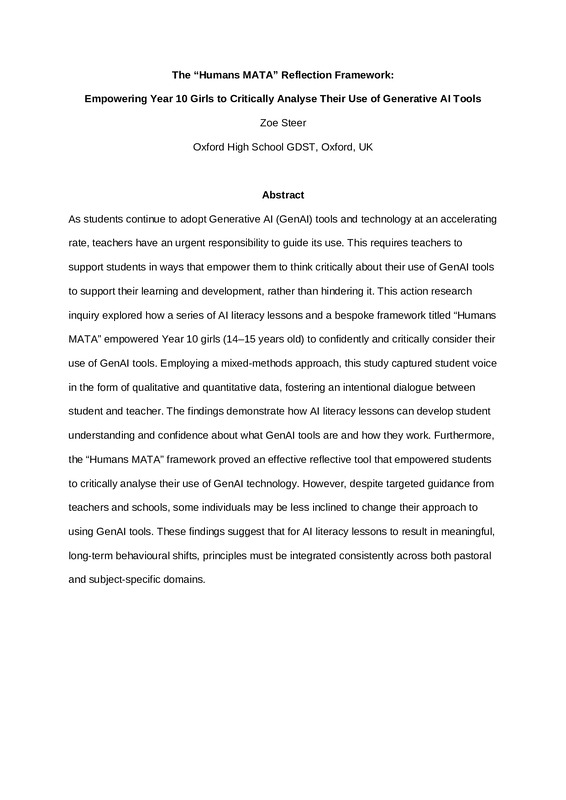 The “Humans MATA” Reflection Framework: Empowering Year 10 Girls to Critically Analyse Their Use of Generative AI ToolsZoe Steer 2026As students continue to adopt Generative AI (GenAI) tools and technology at an accelerating rate, teachers have an urgent responsibility to guide its use. This requires teachers to support students in ways that empower them to think critically about their use of GenAI tools to support their learning and development, rather than hindering it. This action research inquiry explored how a series of AI literacy lessons and a bespoke framework titled “Humans MATA” empowered Year 10 girls (14–15 years old) to confidently and critically consider their use of GenAI tools. Employing a mixed-methods approach, this study captured student voice in the form of qualitative and quantitative data, fostering an intentional dialogue between student and teacher. The findings demonstrate how AI literacy lessons can develop student understanding and confidence about what GenAI tools are and how they work. Furthermore, the “Humans MATA” framework proved an effective reflective tool that empowered students to critically analyse their use of GenAI technology. However, despite targeted guidance from teachers and schools, some individuals may be less inclined to change their approach to using GenAI tools. These findings suggest that for AI literacy lessons to result in meaningful, long-term behavioural shifts, principles must be integrated consistently across both pastoral and subject-specific domains.
 -
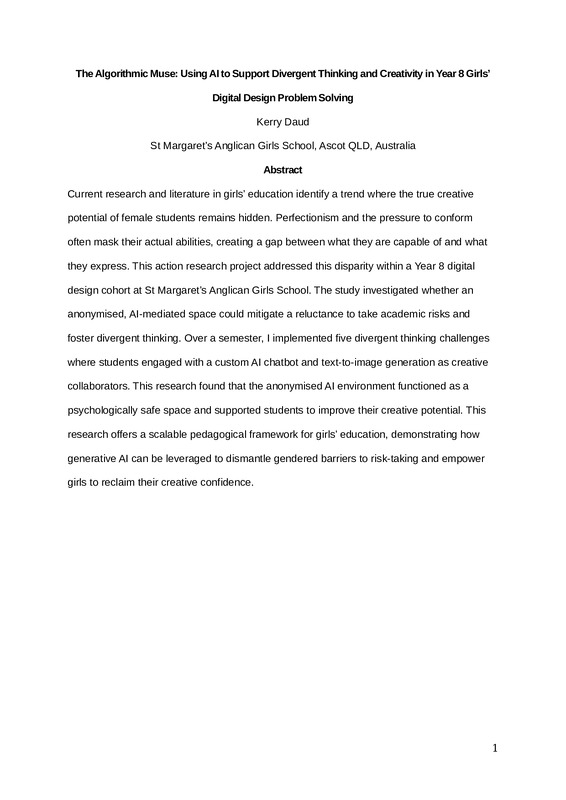 The Algorithmic Muse: Using AI to Support Divergent Thinking and Creativity in Year 8 Girls’ Digital Design Problem SolvingKerry Daud 2026Current research and literature in girls’ education identify a trend where the true creative potential of female students remains hidden. Perfectionism and the pressure to conform often mask their actual abilities, creating a gap between what they are capable of and what they express. This action research project addressed this disparity within a Year 8 digital design cohort at St Margaret’s Anglican Girls School. The study investigated whether an anonymised, AI-mediated space could mitigate a reluctance to take academic risks and foster divergent thinking. Over a semester, I implemented five divergent thinking challenges where students engaged with a custom AI chatbot and text-to-image generation as creative collaborators. This research found that the anonymised AI environment functioned as a psychologically safe space and supported students to improve their creative potential. This research offers a scalable pedagogical framework for girls’ education, demonstrating how generative AI can be leveraged to dismantle gendered barriers to risk-taking and empower girls to reclaim their creative confidence.
 -
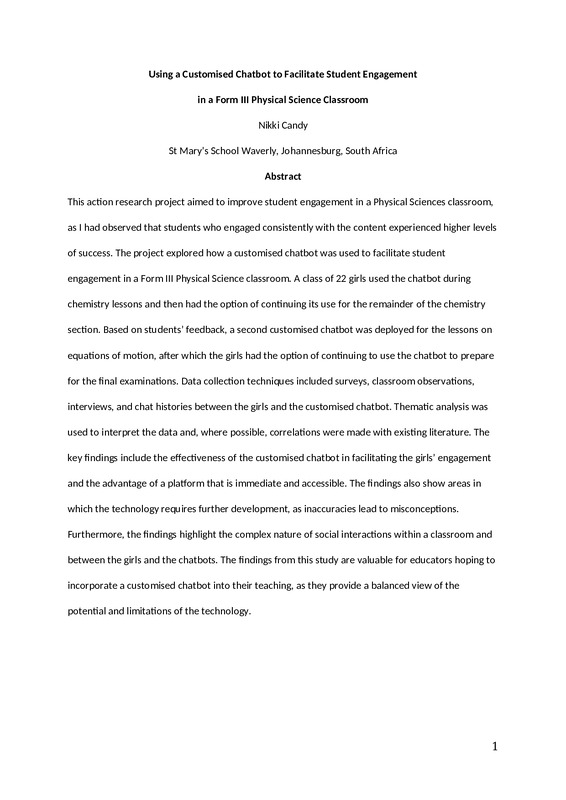 Using a Customised Chatbot to Facilitate Student Engagement in a Form III Physical Science ClassroomNikki Candy 2026This action research project aimed to improve student engagement in a Physical Sciences classroom, as I had observed that students who engaged consistently with the content experienced higher levels of success. The project explored how a customised chatbot was used to facilitate student engagement in a Form III Physical Science classroom. A class of 22 girls used the chatbot during chemistry lessons and then had the option of continuing its use for the remainder of the chemistry section. Based on students’ feedback, a second customised chatbot was deployed for the lessons on equations of motion, after which the girls had the option of continuing to use the chatbot to prepare for the final examinations. Data collection techniques included surveys, classroom observations, interviews, and chat histories between the girls and the customised chatbot. Thematic analysis was used to interpret the data and, where possible, correlations were made with existing literature. The key findings include the effectiveness of the customised chatbot in facilitating the girls’ engagement and the advantage of a platform that is immediate and accessible. The findings also show areas in which the technology requires further development, as inaccuracies lead to misconceptions. Furthermore, the findings highlight the complex nature of social interactions within a classroom and between the girls and the chatbots. The findings from this study are valuable for educators hoping to incorporate a customised chatbot into their teaching, as they provide a balanced view of the potential and limitations of the technology.