
Teaching and Learning
- Title
- Teaching and Learning
Items
-
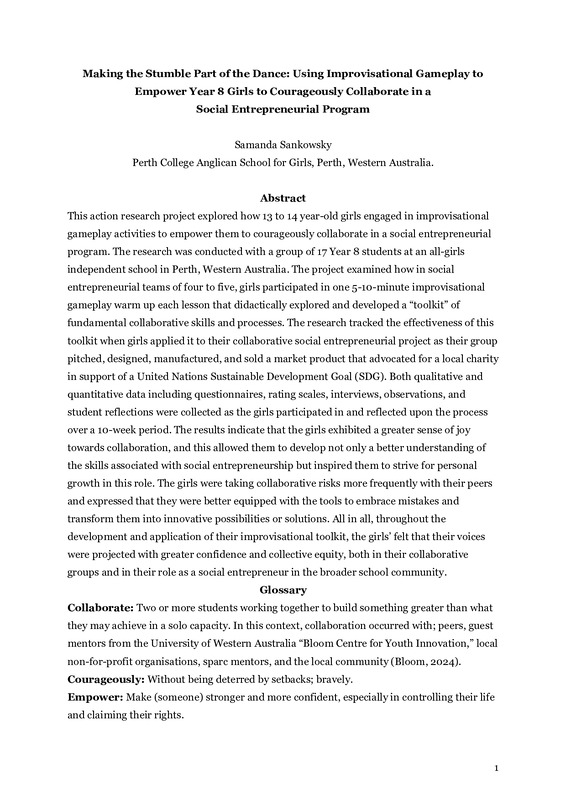 Making the Stumble Part of the Dance: Using Improvisational Gameplay to Empower Year 8 Girls to Courageously Collaborate in a Social Entrepreneurial ProgramSamanda Sankowsky (2024) 2024This action research project explored how 13 to 14 year-old girls engaged in improvisational gameplay activities to empower them to courageously collaborate in a social entrepreneurial program. The research was conducted with a group of 17 Year 8 students at an all-girls independent school in Perth, Western Australia. The project examined how in social entrepreneurial teams of four to five, girls participated in one 5-10-minute improvisational gameplay warm up each lesson that didactically explored and developed a “toolkit” of fundamental collaborative skills and processes. The research tracked the effectiveness of this toolkit when girls applied it to their collaborative social entrepreneurial project as their group pitched, designed, manufactured, and sold a market product that advocated for a local charity in support of a United Nations Sustainable Development Goal (SDG). Both qualitative and quantitative data including questionnaires, rating scales, interviews, observations, and student reflections were collected as the girls participated in and reflected upon the process over a 10-week period. The results indicate that the girls exhibited a greater sense of joy towards collaboration, and this allowed them to develop not only a better understanding of the skills associated with social entrepreneurship but inspired them to strive for personal growth in this role. The girls were taking collaborative risks more frequently with their peers and expressed that they were better equipped with the tools to embrace mistakes and transform them into innovative possibilities or solutions. All in all, throughout the development and application of their improvisational toolkit, the girls’ felt that their voices were projected with greater confidence and collective equity, both in their collaborative groups and in their role as a social entrepreneur in the broader school community.
 -
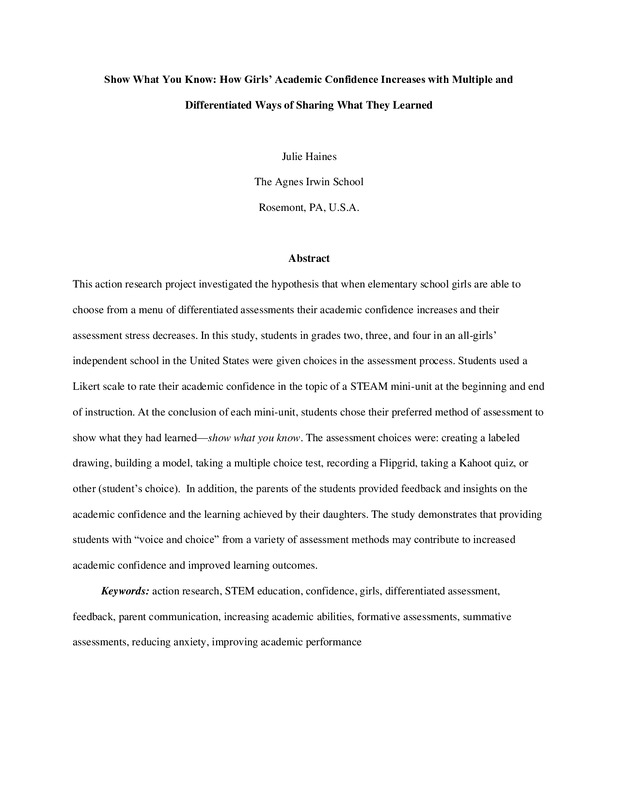 Show What You Know: How Girls’ Academic Confidence Increases with Multiple and Differentiated Ways of Sharing What They LearnedJulie Haines (2020) 2020This action research project investigated the hypothesis that when elementary school girls are able to choose from a menu of differentiated assessments their academic confidence increases and their assessment stress decreases. In this study, students in grades two, three, and four in an all-girls’ independent school in the United States were given choices in the assessment process. Students used a Likert scale to rate their academic confidence in the topic of a STEAM mini-unit at the beginning and end of instruction. At the conclusion of each mini-unit, students chose their preferred method of assessment to show what they had learned—show what you know. The assessment choices were: creating a labeled drawing, building a model, taking a multiple choice test, recording a Flipgrid, taking a Kahoot quiz, or other (student’s choice). In addition, the parents of the students provided feedback and insights on the academic confidence and the learning achieved by their daughters. The study demonstrates that providing students with “voice and choice” from a variety of assessment methods may contribute to increased academic confidence and improved learning outcomes.
 -
Teacher gender biases exist and have long-term effectsRigissa Megalokonomou, Victor Lavy (2023) 2023This article examines the impact of teacher gender biases on student outcomes, particularly in STEM education. Using administrative data from Greece, where students are quasi-randomly assigned to teachers, the study identifies significant gender biases among high school teachers, especially in mathematics. Teachers' biases were measured by comparing student performance on blind (externally graded) and non-blind (teacher-graded) exams. The findings reveal that teachers who favor boys tend to grade male students higher than female students, despite similar performance on blind assessments. This bias adversely affects girls' subsequent academic performance and their likelihood of enrolling in STEM degrees. The study also finds that teacher gender biases are persistent over time and across different classes, indicating deeply rooted attitudes. Students exposed to pro-boy teachers in grade 11 show significant changes in performance and educational choices in grade 12 and beyond. Specifically, girls taught by pro-boy teachers are less likely to pursue STEM degrees, while boys taught by pro-girl teachers are less likely to enroll in university or choose high-quality degrees. These findings underscore the long-term implications of teacher biases on students' educational trajectories and highlight the need for interventions to address and mitigate such biases in educational settings.
-
 The Future of Girls’ Education: Classroom, Curriculum and Culture2024The Girls’ Day School Trust , a unique family of 25 all girls’ schools across England and Wales, has recently released the GDST Insights Report and Framework. This report brings together some of the latest knowledge and research on delivering a world class education for girls. This is an important resource as it provides the tools to support girls to achieve their full potential, even when faced by inequalities and personal prejudice. This report was driven by the findings of the GDST’s landmark 2022 research that showed girls have amazing ambitions and are engaged and enthusiastic about the world.
 -
 The Gender Gap in Teen Experiences(2025) 2025American teens face a host of challenges these days – both inside and outside the classroom. A 2025 Pew Research Center survey of U.S. teens ages 13 to 17 finds that, while there is some common ground, many of the problems and pressure points teens are dealing with differ significantly for boys and girls. In addition, many teens see imbalances in how boys and girls are experiencing school and how they’re performing academically.
 -
 Think, Reflect, Succeed: Using Reflective Thinking Routines to Develop Agency in Year 8 Girls in the French ClassroomTara Fennell (2025) 2025This action research project explored how 12–13 year-old girls engaged in a reflective thinking routine, which aimed at increasing their agency in French lessons. The research was conducted with a group of 14 students at an all-girls independent school in London, England. In this project, students added their questions to a physical question wall, then explored answers and related ideas together. Their discussions supported aspects such as consolidation of complex grammar, writing feedback, and topic revision. Data collected were qualitative in nature and captured by questionnaires, interviews, my field journal, lesson observations, artefacts, and student written work. The results indicated that use of a thinking routine developed individual question competence, peer questions enhanced their classmates’ learning, the question wall provided potential for stretch and challenge, and the transactional nature of the student-teacher dynamic shifted over the ten weeks of the project. The students articulated the positive impact of the project on their sense of agency and discussed how thinking routines could be used moving forward. The effectiveness of the thinking routine with other year groups and other academic subjects can next be ascertained.
 -
 Understanding and supporting neurodiverse girls in mainstream schoolsMilner, V. L., Mohamed, L., & Happ, F 2025“Beyond the stereotype”: Neurodivergent students’ experience and peer and teacher understanding of neurodiversity in a mainstream girls’ school. Neurodiversity , 3. https://doi.org/10.1177/27546330251326056 Overview Researchers from King’s College London studied the experiences of neurodivergent girls (primarily those with autism and ADHD) in a selective all-girls’ school. Their findings shed light on how schools can better support these students. Key Findings Misunderstanding & Assumptions - 93% of students said people don’t understand what it means to be neurodiverse. - Common myths: excelling in one area = excelling in all areas; autism/ADHD are the only forms of neurodivergence. Stigma & Disclosure - Students feared being labeled, stereotyped, or bullied if they disclosed a diagnosis. - Teachers viewed disclosure as essential for adapting instruction, but worried about bias or misinterpretation. Camouflaging & Pressure - Many girls described “performing” to fit in—masking differences at high emotional cost, leading to exhaustion and stress. The Double Empathy Problem - Neurodivergent students felt misunderstood. - Teachers and peers lacked confidence in their understanding. - This mutual gap deepened stigma and isolation. Implications for Schools - Whole-School Education: Incorporate assemblies or lessons to reduce stigma and myths. - Safe Spaces & Trusted Staff: Provide quiet areas and support networks for overwhelmed students. - Inclusive Teaching: Use clear instructions, adapt communication, and show patience with different learning needs. - Amplify Student Voices: Involve neurodiverse girls directly in shaping strategies. - Universal Supports: Offer strategies for all students, including high-achieving but unidentified girls with neurodivergent traits.
 -
 Who Controls the Learning? Examining the Impact of an Autodidactic Framework in a Grade 12 Girls’ Atmospheric Science ClassEric A. Walters (2023) 2023A 21st-century education must move beyond a student acquiring a body of knowledge presented through direct instruction. To find workforce success, students must become adept problem solvers, and, as such, they need to develop the capacity to independently direct their own learning. (Association for Supervision and Curriculum Development, 2022). Future employees will need to be project managers, expected to solve problems they have never seen before. They will not be asked to read a textbook chapter, then answer a series of questions. In my experience as a high school science teacher, students often struggle when they are first introduced to self-directed learning. In this action research project, I investigated if a self-directed learning framework would assist students in strengthening their autonomy through autodidactic experiences. The project was conducted over an eight-week period with students in my senior elective, Atmospheric Science. For the unit, “Introduction to Weather Forecasting,” students were given a learning pathway that outlined all topics they needed to master, along with a set of learning activities to be completed to support the learning. A “Wakelet” playlist with multimodal resources allowed students to develop their knowledge and understanding; students demonstrating mastery by completing activities that used real-time weather data. As a summative assessment, students synthesized their knowledge by researching and producing a short, video weather forecast for a selected city. In my mixed-methods research design, I implemented a self-directed learning assessment and metacognitive awareness inventory. Student reflections, classroom observations, focus groups, and contemporaneous comments also helped me understand changes in learning patterns. Data analysis suggested that students ended up in two camps: those with a fixed mindset who struggled with self-directed learning and those with a growth mindset who excelled with project planning. My results suggested that self-directed learning experiences must be carefully balanced with the students’ desire for collaborative work during learning. Furthermore, there must be an ongoing conversation between teacher and student about how students might understand their learning personas and thereby build agency in all types of learning.